Utah County Dog Registration Information
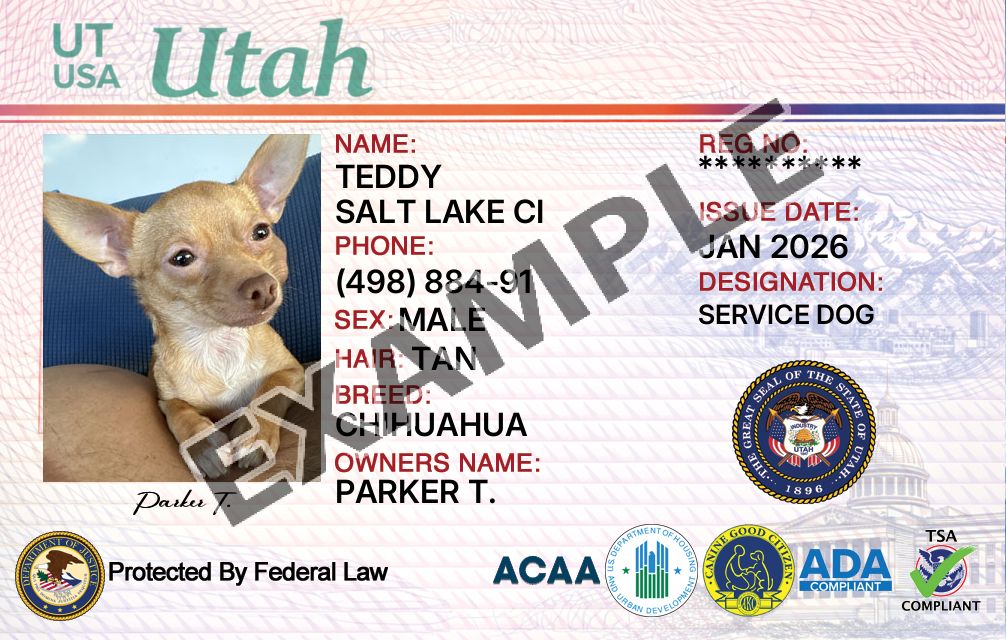
Service Dogs and Emotional Support Animals in Utah, Utah
If you’re asking “where do I register my dog in Utah County, Utah for my service dog or emotional support dog,” the key thing to know is that most “registration” in everyday use actually means local dog licensing (often handled by your city animal control or a regional animal shelter that provides licensing for multiple cities). Service dogs and emotional support animals (ESAs) are not licensed through a single universal federal registry; however, your dog may still need a dog license in Utah County, Utah based on where you live.
Where to Register or License Your Dog in Utah County, Utah
Utah County does not operate a single “one-stop” countywide dog registration office for every resident in every city. Instead, licensing is commonly handled at the city level and may be supported by regional animal shelter/animal services organizations that serve multiple municipalities. Below are official public agencies and the primary regional shelters referenced by Utah County cities for licensing and animal services.
Provo Police Department — Animal Control (Provo City Licensing)
North Utah Valley Animal Shelter (NUVAS) — Regional Shelter Serving Northern Utah County Cities
South Utah Valley Animal Shelter (SUVAS) — Regional Shelter Serving Southern Utah County Cities
Orem Police Department — Animal Control (Orem City)
Overview of Dog Licensing in Utah County, Utah
What “dog registration” typically means locally
In most Utah County cities, “registering” a dog means getting a local dog license. A license is usually issued by a city (or a city partner such as an animal shelter) and is used for identification, compliance, and public health purposes. This is separate from any training program, disability documentation, or housing paperwork.
Why cities require a dog license
- Public health: licensing is commonly tied to current rabies vaccination.
- Reunification: a license helps return a lost dog to its owner faster.
- Local enforcement: supports animal control services (leash laws, at-large rules, nuisance ordinances).
- Planning and records: helps municipalities track owned animals within city limits.
What You Need Before Registering a Dog
Common dog licensing requirements in Utah County, Utah
While requirements vary by city, many Utah County licensing offices ask for similar information. Plan to have:
- Proof of current rabies vaccination (often required to issue the license)
- Your contact information (name, address, phone)
- Proof of residency (sometimes requested, especially if multiple cities share a shelter)
- Spay/neuter documentation (if your city uses different fees for altered vs. unaltered pets)
- Payment for the licensing fee (fee amounts vary by city and animal status)
If your dog is a service dog or emotional support animal
Being a service dog or ESA does not automatically replace municipal dog licensing rules. You may still need to comply with the animal control dog license Utah County, Utah rules where you live, including rabies vaccination documentation.
Steps to Register or License a Dog in Utah County, Utah
Step 1: Confirm your licensing jurisdiction (city vs. regional shelter)
Utah County includes many municipalities, and licensing is commonly managed at the city level. Start by confirming:
- Which city you reside in (your physical address determines jurisdiction)
- Whether your city licenses directly (through animal control/city office) or uses a regional shelter partner
Step 2: Gather vaccination and identification documents
Licensing commonly requires proof of current rabies vaccination. If your paperwork is missing, contact your veterinarian for records before visiting or calling the licensing office.
Step 3: Apply and pay the fee (in person or by the method your city uses)
The exact method varies. Some Utah County cities direct residents to obtain a license through a partnered shelter; other cities handle licensing through their own animal control operation.
Step 4: Keep your license current
Many cities treat licensing as an annual obligation. If your address changes within Utah County (for example, moving from Orem to Provo), you may need to update your licensing with the correct city or partner office.
Service Dog Laws in Utah County, Utah
No universal federal service dog registration
Service dogs are generally recognized by what they do (trained tasks that assist a person with a disability), not by being listed in a single federal registry. You can still be asked to follow local requirements such as a dog license and rabies vaccination documentation where applicable.
Service dog status vs. local licensing
A service dog may be exempt from certain “no pets” policies in public accommodations, but local licensing rules can still apply. In practical terms:
- Service dog access concerns where the dog can accompany its handler.
- Dog licensing requirements in Utah County, Utah concern municipal animal control rules (vaccination proof, license renewal, tags).
Emotional Support Animal Rules in Utah County, Utah
No single universal ESA registration
Emotional support animals are not service animals under the same public-access rules. ESAs are most commonly relevant in housing contexts. Like service dogs, ESAs are not “made official” by a single universal federal government registry.
ESA status vs. local licensing
Even if your dog is an emotional support animal, your city may still require you to obtain a dog license in Utah County, Utah and show proof of rabies vaccination. ESA status does not typically replace municipal animal control requirements.
Dog License vs. Service Dog vs. Emotional Support Animal (Comparison)
| Category | Dog License (Local Licensing) | Service Dog | Emotional Support Animal (ESA) |
|---|---|---|---|
| What it is | A municipal license/permit for owning a dog within city limits. | A dog trained to perform tasks that assist a person with a disability. | An animal that provides emotional support; commonly addressed in housing contexts. |
| Who issues/recognizes it | Your city/municipality or its designated animal services partner. | Recognized under applicable disability laws based on training and function; not created by a single registry. | Generally supported by appropriate documentation for housing; not created by a single registry. |
| Typical proof requested | Often proof of rabies vaccination; possibly spay/neuter status and residency. | Usually not a “certificate”; eligibility is based on the dog’s trained tasks and handler’s disability-related need. | Often documentation for housing accommodation requests; not a license. |
| Public access (stores, restaurants, city buildings) | No special access rights by itself. | Generally allowed where the public is allowed, with limited exceptions. | Does not generally provide public-access rights. |
| Does it replace local licensing? | Not applicable. | Usually no—local dog licensing rules may still apply by city. | Usually no—local dog licensing rules may still apply by city. |
Frequently Asked Questions
Do I need to license a service dog in Utah County, Utah?
In many cases, yes. Service dog status is separate from municipal licensing. If your city requires dogs to be licensed and requires proof of rabies vaccination, that requirement commonly applies regardless of whether the dog is a service dog.
Do I need to license an emotional support dog in Utah County, Utah?
Often, yes. ESA status typically relates to housing accommodations and does not replace city animal control rules such as licensing, rabies vaccination, or leash laws.
Is there a single Utah County office that registers all dogs?
Not usually. Utah County includes multiple cities, and dog licensing is commonly handled by your municipality and/or a regional shelter that provides licensing services for multiple cities. If you’re unsure where you fall, call the closest official animal control contact listed above and ask which office handles your address.
What is usually required to get a dog license?
Many cities require proof of rabies vaccination to issue a dog license. You may also need identification, proof of residency, and (if applicable) spay/neuter documentation.
I live in Utah County but not in Provo or Orem. Where should I start?
Start with your city government’s animal control or licensing contact. If your city contracts with a regional shelter, you may be directed to NUVAS (Lindon) or SUVAS (Spanish Fork) for licensing and animal services support.
Register A Dog In Other Utah Counties
Select your county below to get started with your dog’s ID card. Requirements and license designs may vary by county, so choose your location to see the correct options and complete your pup’s registration.
- Beaver County Dog Registration
- Box Elder County Dog Registration
- Cache County Dog Registration
- Carbon County Dog Registration
- Daggett County Dog Registration
- Davis County Dog Registration
- Duchesne County Dog Registration
- Emery County Dog Registration
- Garfield County Dog Registration
- Grand County Dog Registration
- Iron County Dog Registration
- Juab County Dog Registration
- Kane County Dog Registration
- Millard County Dog Registration
- Morgan County Dog Registration
- Piute County Dog Registration
- Rich County Dog Registration
- Salt Lake County Dog Registration
- San Juan County Dog Registration
- Sanpete County Dog Registration
- Sevier County Dog Registration
- Summit County Dog Registration
- Tooele County Dog Registration
- Uintah County Dog Registration
- Wasatch County Dog Registration
- Washington County Dog Registration
- Wayne County Dog Registration
- Weber County Dog Registration